Home >>
Blogs
>>
Hybrid Ready Learning Environment
What Makes a Learning Environment ‘Hybrid-Ready’ Beyond Streaming
Anyone who has taught or attended a hybrid class knows the difference between watching a classroom and participating in one. They’re not the same experience.
For a while, educational institutions thought hybrid learning had a fairly simple formula.Put a camera in the classroom. Connect to a video conferencing platform. Stream the lecture. Done.
The class is now “hybrid.” Except students didn’t see it that way. Neither did the faculty.
A student sitting in the front row can ask questions instantly. They can join discussions. They can catch visual cues from the instructor. They can engage naturally.
A student attending remotely often faces a different reality. Audio drops. Questions get missed. Classroom discussions become difficult to follow. Participation feels delayed.
The technology works. The learning experience doesn’t.
That’s why the conversation around hybrid learning has changed.
Today, institutions aren’t asking how to stream classes. They’re asking how to create learning environments where every student feels equally connected, regardless of where they are. And that’s a much bigger challenge.
The Real Goal Is Participation Parity
Here’s a simple test.
Imagine a professor who attends a class in marketing. In the room are twenty students sitting. Ten students are joining remotely. The professor asks a question. In the classroom, five students instantly raise their hands. Three of the students, all online, type responses into the chat.
Who gets noticed first? In many classrooms, the answer is obvious. The students physically present.
Not because anyone intends to ignore remote learners. The infrastructure simply wasn’t designed to support equal participation.
This is where hybrid readiness begins. A hybrid-ready environment creates participation parity.
In practical terms, that means:
Remote students can contribute as easily as in-person students
Every learner can hear discussions clearly
Questions are captured without delay
Collaborative activities include everyone
Learning feels connected instead of divided
Without participation parity, hybrid learning becomes two separate experiences running at the same time.
One active. One passive.
Why Audio Deserves More Attention Than Video
Most institutions focus on cameras first. That’s understandable. Cameras are visible. They feel important.
Audio often gets less attention. That’s a mistake.
Ask students what frustrates them more. A video feed that occasionally freezes. Or an instructor who sounds distant and unclear. The answer usually comes fast. People tolerate imperfect video. They don’t tolerate missing half the lesson.
Think about what happens during a classroom discussion. A student sitting at the back asks a question. Several classmates respond. The instructor adds context.
If microphones aren’t designed to capture those interactions, remote students lose an entire layer of learning. And classroom discussions often contain the most valuable moments.
Strong hybrid environments invest in:
Room-wide microphone coverage
Clear voice reinforcement
Noise reduction
Consistent audio levels
High-quality speaker systems
Good audio keeps everyone connected to the conversation. Poor audio pushes remote learners to the sidelines.
Hybrid Learning Is No Longer a Niche Model
Student expectations have changed. The numbers tell a clear story.
Around 69% of students globally prefer online, hybrid, or blended learning models over strictly traditional classroom formats.
Nearly 49% of learners worldwide have already completed some form of online or hybrid coursework.
Around 75% believe online learning delivers equal or greater value than conventional learning environments.
Those figures matter. They show that hybrid learning is no longer viewed as a temporary alternative.
Students increasingly expect flexibility, access, and continuity.
Educational institutions that ignore those expectations risk creating learning experiences that feel outdated.
Interactive Displays Change How Students Engage
One challenge appears in almost every hybrid classroom. The instructor starts writing on a whiteboard. Students in the room can follow easily. Remote students struggle.
The camera angle isn’t perfect. The handwriting isn’t clear. The board isn’t fully visible. A few minutes later, attention starts drifting.
Interactive displays solve this problem because they create a shared visual experience. Whether students sit in the classroom or attend remotely, everyone sees the same content.
That includes:
Live annotations
Presentations
Diagrams
Videos
Lesson materials
The difference sounds small. The impact isn’t.
Studies show that these digital and hybrid learning spaces have the potential to increase knowledge retention by 25% to 60%, which is compared to just 8% to 10% in a traditional non-digital space.
Better visibility contributes directly to better engagement. And engagement drives retention.
Faculty Shouldn’t Need to Become AV Experts
Let’s be honest. Most instructors don’t want to spend ten minutes troubleshooting technology before every class. Yet many hybrid classrooms unintentionally force them into that role. The class begins in five minutes.
The instructor is checking the microphones.
Switching display inputs.
Adjusting camera settings.
Testing audio.
Restarting software.
Students are waiting. Momentum disappears before the lesson even begins.
Hybrid-ready environments remove that friction. Technology should support teaching. Not compete with it.
That’s why institutions increasingly invest in integrated systems with simple touch-based controls, automated workflows, and unified classroom management tools.
When technology becomes easier to operate, faculty focus more on teaching. Students benefit immediately.
Learning Doesn’t End When Class Ends
Here’s another shift many institutions are noticing. Students don’t learn in one sitting anymore. They revisit material. Often multiple times.
A recorded lecture becomes useful when:
Preparing for exams
Reviewing difficult concepts
Catching up after an absence
Completing assignments
Supporting self-paced learning
This is where recording and streaming systems create long-term value. A single lecture becomes an ongoing learning resource. And students appreciate that flexibility.
Research indicates that digital learning settings typically take between 40% and 60% less study time and do so without compromising learning effectiveness.
Part of that efficiency comes from giving students access to content whenever they need it. Not only during scheduled classroom hours.
Studio Rooms Are Becoming Strategic Assets
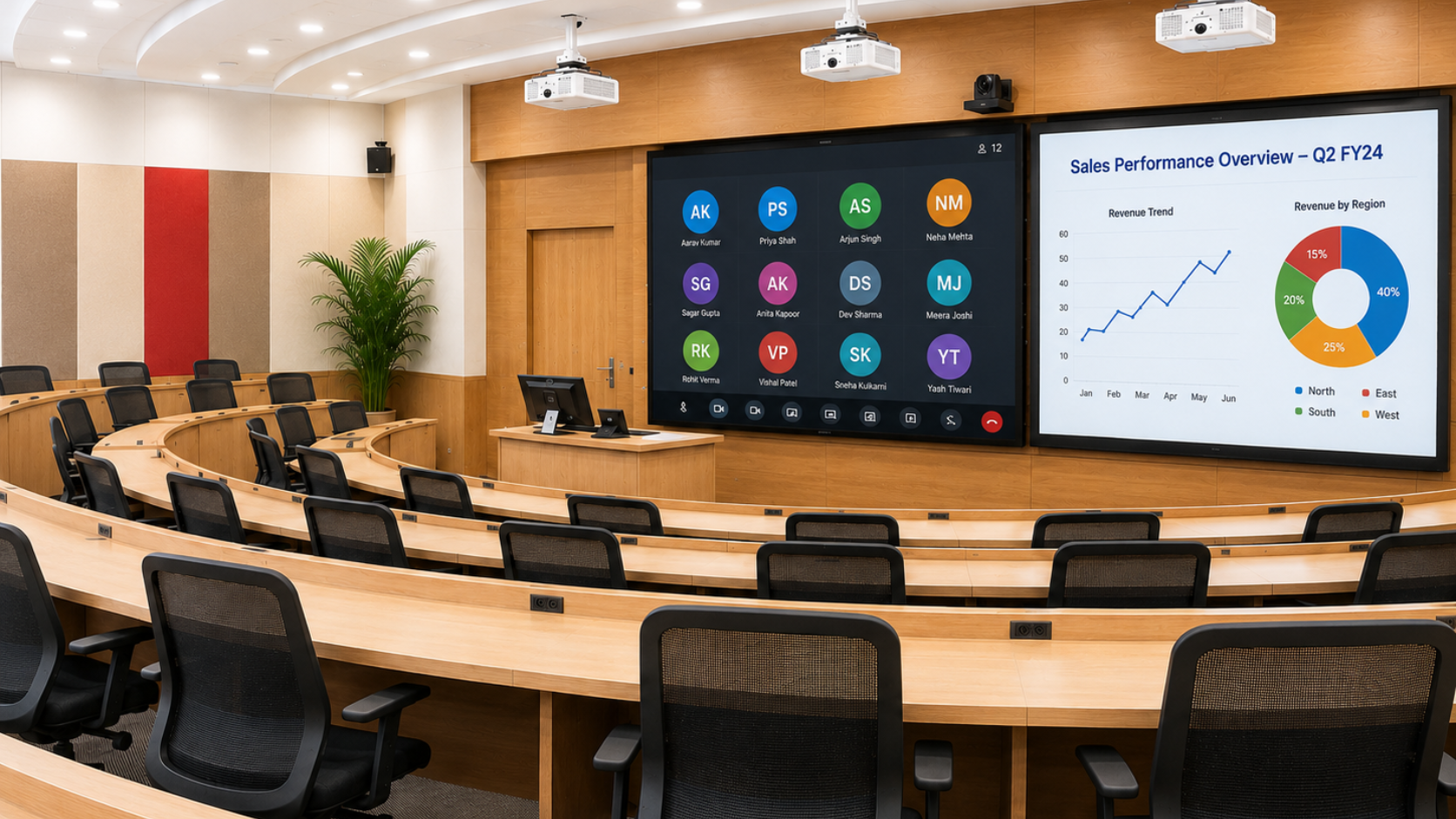
Many institutions are creating dedicated studio rooms. At first glance, they resemble classrooms. In practice, they serve a different purpose. Studio rooms are designed specifically for hybrid and online learning delivery.
The setup typically includes:
Interactive displays
Professional microphones
Video conferencing systems
Recording platforms
Streaming technology
Classroom audio systems
The advantage? Consistency.
Whether a faculty member teaches students across campuses, cities, or countries, the learning experience remains structured and professional.
As institutions expand their reach, studio rooms help maintain quality across locations.
Large Spaces Need a Different Approach
Hybrid learning becomes more complex in seminar halls and auditoriums. A classroom with thirty students presents one set of challenges. An auditorium with five hundred attendees presents another.
Imagine a guest lecture attended by students on campus and hundreds more joining remotely.
Everyone needs to:
See the presenter clearly
Hear every word
Follow presentations without difficulty
Participate when required
That’s why large learning spaces increasingly rely on:
Requirement
Supporting technology
Wide visibility
Active LED displays, video walls, high-lumen projectors
Clear audio
Line-array speaker systems and advanced microphones
Remote participation
Video conferencing systems
Session recording
Recording and streaming platforms
Centralized management
Touch-based room controls
The objective stays the same. Create one learning experience. Not separate experiences running in parallel.
AI Is Changing Learning Expectations Too
There’s another trend influencing hybrid readiness. AI.
A recent poll found that most students (86%) said they use AI in their studies. They use it on a regular basis as well.
Students use AI to:
Summarize lectures
Review concepts
Generate study guides
Organize notes
Prepare for assessments
Those workflows depend on access to digital content.
No recordings? Limited value.
No searchable learning resources? Limited value.
No digital repository? Limited value.
The quality of AI-supported learning often depends on the quality of the institution’s digital learning infrastructure.
Which brings us back to hybrid readiness.
So, What Makes a Learning Environment Truly “Hybrid-Ready?”
Not a webcam. Not a streaming platform. Not a single piece of technology.
A hybrid-ready learning environment combines multiple elements into one connected experience.
The strongest environments support:
Clear communication
Equal participation
Reliable audio
Interactive content sharing
Seamless video conferencing
Lecture recording
Flexible access
Simple faculty workflows
Consistent learning experiences across locations
When those pieces come together, location becomes less important. Learning becomes the focus again. And that’s the outcome institutions are working toward.
Building Future-Ready Educational Spaces with Resurgent
Hybrid learning succeeds when technology supports participation, engagement, and continuity across every learning environment.
Resurgent helps educational institutions design and implement integrated AV solutions that bring those goals within reach.
From digital classrooms and studio rooms to seminar halls and auditoriums, Resurgent delivers technologies that improve visibility, strengthen communication, and support meaningful interaction between physical and remote learners.
Solutions include:
Interactive displays and smart boards
Software-based video conferencing systems
Recording and streaming platforms
Professional speakers and microphones
Active LED displays and video walls
Signal transmission systems
Touch-based room control solutions
The result is a learning environment that supports students wherever they are, while helping faculty teach with confidence and consistency.
As hybrid education continues to evolve, institutions need infrastructure that supports today’s expectations and tomorrow’s opportunities.
Contact Resurgentto explore integrated AV solutions that help create engaging, connected, and truly hybrid-ready learning environments.
FAQs
What is a “hybrid-ready” learning environment? A learning space that enables equal participation, engagement, and access for both in-person and remote students.
Why is streaming alone not enough? Streaming shares content, but effective hybrid learning also requires interaction, collaboration, and clear communication.
Why is audio so important in hybrid classrooms? Poor audio causes students to miss discussions and instructions, reducing engagement and learning quality.
What role do recording systems play in hybrid learning? They allow students to revisit lessons anytime for revision, catch-up learning, and better retention.
How can Resurgent support hybrid-ready education? Resurgent delivers integrated AV solutions that help institutions create connected, engaging, and future-ready learning environments.
Rethink the standard meeting room. Learn how finance reviews, board updates, and cross-region meetings need different AV design and spatial intent. Does every meeting room in your office look the same? Same table. Same chairs. Same screen. Same camera. Now ask yourself. Do all your meetings behave the same way? Yet most enterprises replicate one […]
Why Leadership Conversations Break Down First And How Rooms Play a Role
Why leadership conversations fail due to room design. Learn how audio delay, eye-line gaps, and AV fatigue weaken executive decisions. Have you noticed this pattern? The strategy looks solid on paper. The leaders agree in pre-reads. The numbers align. Then the meeting begins, and something shifts. People repeat points. Someone asks to restate a question. […]
When the Room Becomes the Third Person in the Deal
How meeting rooms shape authority, trust, and deal outcomes. Learn how AV design influences senior buyers during high-stakes business conversations. You walk into a boardroom ready to close a deal. The numbers hold. The strategy feels tight. The people around the table look prepared. Yet something feels off. The screen flickers. Audio lags. Someone struggles […]