How to Improve Speech Intelligibility in Modern Meeting Rooms
Modern meeting rooms are no longer simply spaces with a display and a conference speaker. With hybrid collaboration, remote participants, video conferencing, and distributed teams becoming part of everyday business, clear and intelligible speech has become one of the most important factors in meeting room design.
High-resolution displays and collaboration technology can make a meeting a lot more advanced, but if you can’t hear what is being said, the technology is not doing its job. That makes speech intelligibility one of the essential design factors to keep in mind when designing an AV system for a conference room.
What is Speech Intelligibility?
Speech intelligibility refers to how easily listeners can understand spoken words. Good speech intelligibility is achieved when participants can understand the speech of all the speakers without needing to ask for repetition in a meeting room.
There are several factors that affect the intelligibility of speech:
- Microphone placement
- Speaker positioning
- Room acoustics
- Background noise
- Reverberation
- Audio processing
- Room size and layout
- Distance between speakers and microphones
An effective meeting room design considers all these factors together rather than treating audio as an individual equipment selection.
Why is Speech Intelligibility Important?
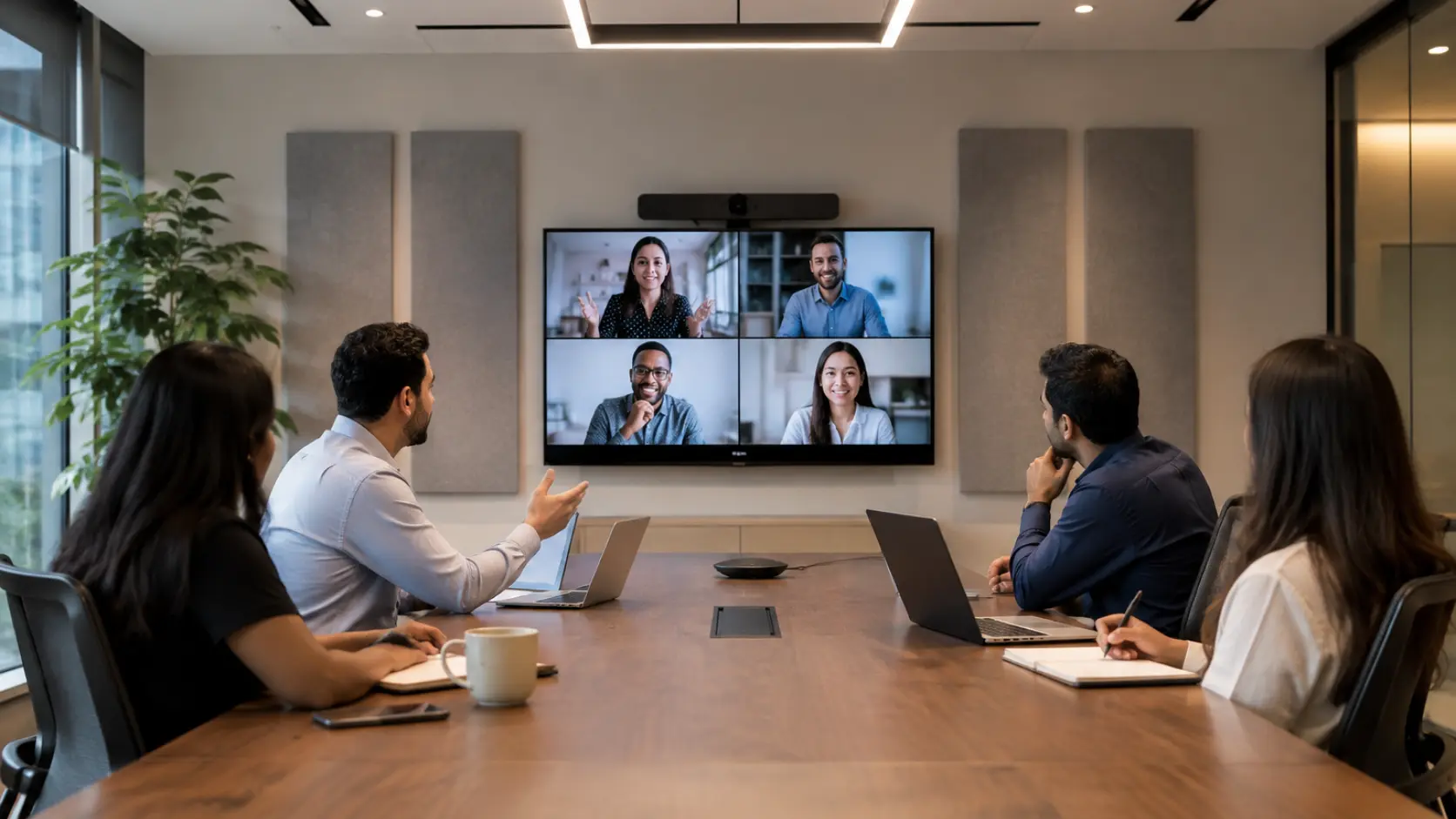
The new world of meetings and conferences has changed how people communicate. Participants can sit in a room, work remotely or connect from various locations during meetings.
This means that there should be extra requirements for audio systems. A participant sitting at the far end of a conference table should be heard as clearly as someone sitting directly in front of the microphone. Remote participants should also be able to distinguish different speakers without excessive background noise or echo.
With suboptimal audio, the meeting could lose information, conversations might repeat, less engagement, and meeting fatigue. Thus, speech intelligibility should be taken into account when designing the room, and not as an add-on.
Start With the Room, Not the Equipment
One of the most common mistakes in meeting room design is selecting microphones and speakers before understanding the room.
When creating meeting room AV solutions, keep the following in mind:
- Room dimensions
- Number of participants
- Table configuration
- Ceiling height
- Wall and ceiling materials
- Glass surfaces
- HVAC noise
- Expected background noise
- Number of participants who are not onsite.
- The need for meeting and collaboration.
A large boardroom, small huddle room, training room, and divisible conference space will each require different audio approaches.
Manage Room Acoustics
Even high-quality microphones cannot completely compensate for poor room acoustics. Reflections of sound can occur on hard surfaces like glass, concrete, and untreated walls. Speech can become unclear when several reflections arrive at different times of the listener.
Acoustic treatment can help control these reflections. Depending on the room, solutions may include acoustic wall panels, ceiling treatments, carpets, curtains, and appropriate furniture.The goal isn’t to just make the room quieter. The aim is to develop an acoustic context that allows speech to be heard and understood.
Select the Ideal Microphone
The type of microphone should be determined by the room configuration and the type of communication among the participants.
Common options include:
- Tabletop microphones
- Ceiling microphones
- Beamforming microphones
- Boundary microphones
- Wireless microphones
Beamforming or ceiling microphones offer more flexibility in larger conference rooms for capturing participants over a broader area.
Also, the microphone placement is equally important. A microphone positioned too far from the speaker may capture more room noise and reverberation, while placing it too close can create inconsistent audio levels.
Placement of Speaker
Speakers should distribute sound evenly throughout the room.
Instead of simply increasing speaker volume, designers should focus on achieving consistent coverage. Participants should hear speech clearly regardless of where they are sitting.
For an AV system for conference room deployment, speaker positioning should take into account seating arrangements, room dimensions, display locations, and microphone positions.
The system should also not allow acoustic feedback to occur between the microphones and the speakers.
Use DSP to Improve Audio Performance
Digital Signal Processing (DSP) is an important part of a meeting room audio solution.
A good sounding DSP can be used to control:
- Acoustic echo cancellation
- Automatic gain control
- Noise reduction
- Equalization
- Feedback suppression
- Microphone mixing
- Audio routing
For example, acoustic echo cancellation helps prevent remote participants from hearing their own voices returning through the meeting room’s speakers.
DSP configuration should be based on the room’s acoustic characteristics and equipment rather than relying solely on default settings.
Hybrid Meeting Challenges
One of the biggest hybrid meeting challenges is maintaining consistent audio quality between people in the room and participants joining remotely.
The whole group (whether remote or in the room) must rely on the microphones and audio processing in the room to hear each other. At the same time, the participants in the room must be able to clearly hear the remote speakers without any interruption.
Common problems include:
- Echo
- Audio dropouts
- Uneven microphone levels
- Background noise
Integrate Video and Audio as One System
Audio should not be treated as an isolated component of the meeting room.
Modern enterprise AV solutions bring together the microphone, speaker, display, camera, control, video conferencing, and room scheduling technologies in a single place.
For example, when a meeting starts, the system can automatically activate the display, connect the conferencing platform, select the appropriate camera and microphone, and adjust the room’s audio settings.
This reduces the number of manual steps required from users and creates a more consistent meeting experience.
Test Speech Intelligibility Before Handover
A meeting room should be tested under realistic operating conditions before it is handed over to the client
Testing should include:
- Different seating positions
- Multiple people speaking
- Participants joining remotely.
- Background HVAC noise
- Different microphone positions
- Low, medium, and high volume of sounds
- Repeats and confirms.
It is especially important to listen from the other person’s perspective. A system can sound great in the room, but deliver a low quality audio feed when users log in from a distance.
Here is where the expertise of a professional AV system integrator can help. They are able to assess the entire room environment, adjust equipment and tweak the system to meet actual use.
The Role of Professional AV Integration
Intelligibility is more than just having high-end equipment. It depends on coordinating every element, from room acoustics and equipment selection to system design, installation, configuration, and testing.
Professional AV integration helps organizations ensure that meeting rooms function as integrated AV environments rather than as a collection of standalone technologies.
Meeting room technology will continue to evolve in the AI era. But one thing will remain constant: people need to hear and understand each other clearly.
Whether you’re designing a small huddle space or a large boardroom, speech intelligibility should be a key design goal. With the right acoustic planning, microphone technology, speaker placement, DSP configuration, and system integration, a meeting room can become a reliable environment for clear communication and productive collaboration.
Resurgent AV Integrators is a leading audio-visual integration company delivering end-to-end AV solutions for modern workplaces. With expertise in meeting rooms, collaboration spaces, boardrooms, and enterprise environments, we design technology around the needs of users.Our solutions combine audio, video, control, collaboration, and room technologies to create seamless meeting experiences.
Looking to design a smarter meeting room? Contact us to discuss your AV requirements.
FAQ
1. What does speech intelligibility in a meeting room mean?
Speech intelligibility refers to how clearly spoken words can be heard and understood by everyone in the room, including remote participants.
2. What is the 38% rule in room acoustics?
The 38% rule suggests positioning the main listening area around 38% of the room’s length to help achieve more balanced sound and reduce the impact of room modes.
3. How can I improve speech intelligibility in a conference room?
Start with proper acoustic planning, select suitable microphones and speakers, position them correctly, configure the DSP, and test the system from both in-room and remote participants’ perspectives.
4. How do you measure speech intelligibility in a meeting or conference room?
Speech intelligibility is commonly measured using STI (Speech Transmission Index), which evaluates how clearly speech can be understood in a room. Testing also considers factors such as background noise, reverberation, and speaker coverage. Higher STI values generally indicate clearer and more intelligible speech.
5. Can AV system integrators help improve speech intelligibility?
Yes. Professional AV system integrators can assess the room, recommend suitable equipment, design the audio system, configure and install the equipment, and test the complete solution for clear and consistent communication.
Written By
Surendar Kannan
(Alchemist – Design & Estimation)