As organizations become more connected and security threats grow increasingly complex, having a centralized space to monitor and respond to incidents is no longer a luxury, it’s a necessity. Whether it’s safeguarding digital assets from cyberattacks or ensuring the safety of people and facilities, organizations need dedicated environments where critical information can be monitored in real time.
That’s where GSOC rooms and SOC rooms come into play.
Both are command centers for the monitoring and incident response, but they have different functions. A Global Security Operations Center (GSOC) room is designed for physical security, operational intelligence and business continuity while a Security Operations Center (SOC) room is for protection of the IT infrastructure of an organization against cyber threats.
Explore GSOC Room vs SOC Room, their roles in physical and cybersecurity, design considerations and choose the right security operations center for your organization.
What is a GSOC Room?
A Global Security Operations Center (GSOC) room is a single room in which security staff watch over one or more locations for physical security systems, operational risks, emergency situations and business continuity.
Serving as the heart of modern enterprises, a GSOC room helps organizations maintain operational resilience by providing real-time visibility into critical security events and business operations.
A contemporary GSOC room will incorporate:
- CCTV surveillance systems
- Access control systems
- Visitor management systems
- Fire and intrusion alarms
- Building Management Systems (BMS)
- Use of GIS mapping and location tracking
- Incident management software
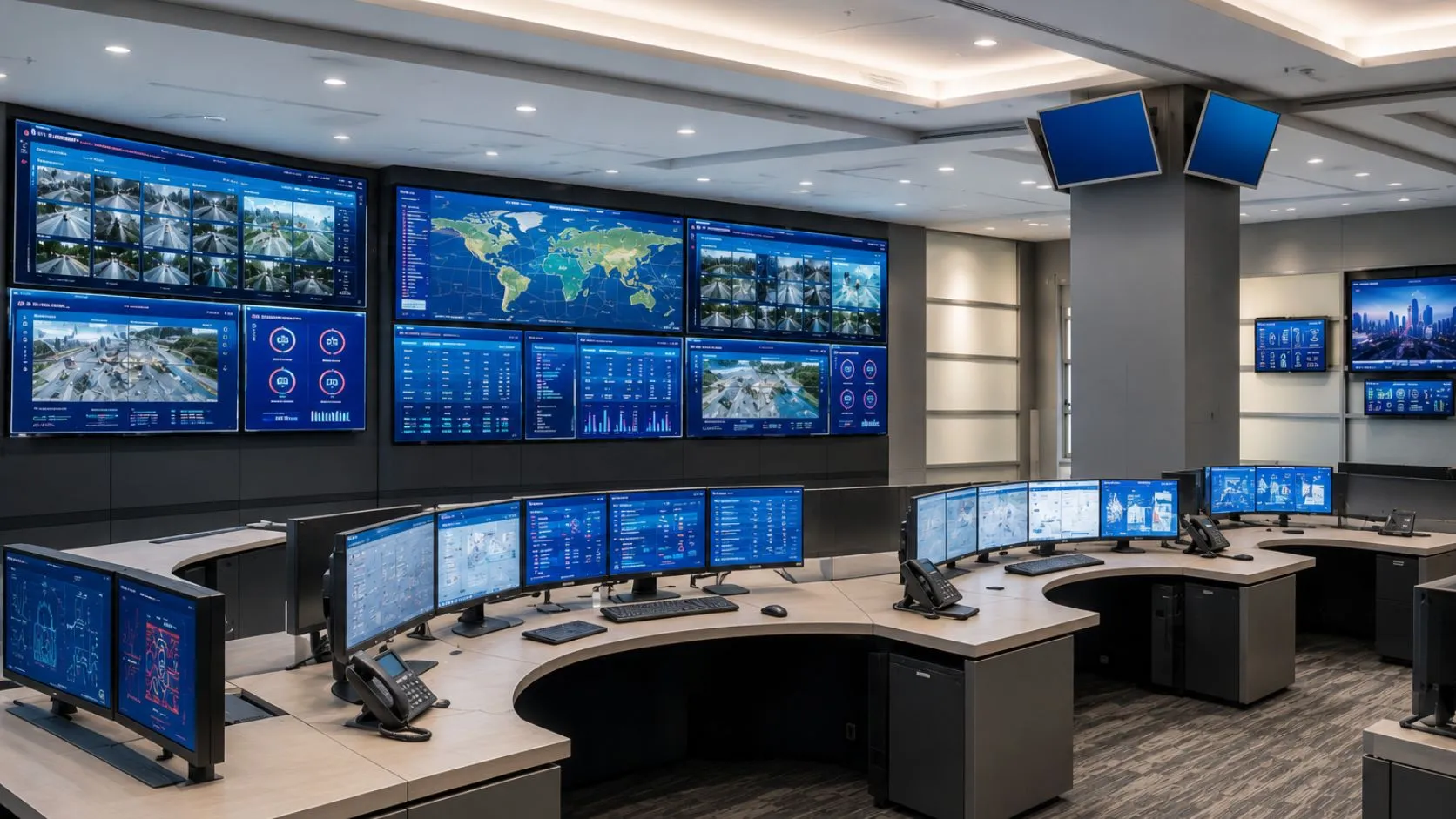
Large video walls display live camera feeds, interactive maps, alarms, and operational dashboards, enabling operators to maintain complete situational awareness.
GSOC rooms are commonly found in airports, manufacturing facilities, corporate headquarters, logistics companies, healthcare campuses, educational institutions, smart cities, and critical infrastructure environments.
What Is a SOC Room?
A Security Operations Center (SOC) room is a designated area that serves as a central hub for cybersecurity practitioners to monitor and track potential cyber threats within an organization.
A SOC room is an environment that detects malicious activity on the network, endpoints, cloud platforms, applications and data systems.
The typical SOC room includes:
- Security Information and Event Management (SIEM)
- Endpoint Detection and Response (EDR)
- Security Orchestration, Automation and Response (SOAR)
- Intrusion Detection and Prevention Systems (IDS/IPS)
- Threat intelligence platforms
- Vulnerability management solutions
- Network monitoring dashboards
Operators analyze security alerts, investigate suspicious behavior, contain cyber incidents, and coordinate recovery efforts to minimize business disruption.
Both rooms have 24/7 operations and are monitored centrally, but are very different from one another in their responsibilities and technologies.
Designing a Modern GSOC Room
Modern GSOC rooms often function as digital war rooms, providing a centralized environment where live video feeds, security dashboards, incident alerts, GIS maps, and communication systems are brought together on a single platform. This integrated workspace enables security teams to visualize critical information, collaborate effectively, and make faster, well-informed decisions during routine operations and high-priority incidents.
Key components include:
- Large format real-time visualization video walls
- Ergonomic operator consoles designed for continuous operation
- Multi-monitor workstations
- Integrated AV distribution systems (IADS)
- Integrated communication systems
- Excessive network and power redundancy
- Acoustic treatment for clear communication
A successful GSOC room will enable the operators to keep a watch on various facilities and work smoothly with emergency responders and business managers.
Designing a Modern SOC Room
While the objectives of GSOC and SOC rooms differ, both depend on business AV solutions to create centralized monitoring environments where operators can access critical information, communicate efficiently, and respond to incidents with greater speed and accuracy. SOC rooms have a focus on information visibility and analyst productivity. The room is designed to enhance the ability to collaborate and reduce fatigue, as cybersecurity analysts can spend many hours reviewing security data.
Common features of design are:
- High-resolution monitoring displays
- Dashboard visualization walls
- Adjustable operator workstations
- Low-latency network connectivity
- Secure access controls
- Incident Response Team collaboration areas
- Robust infrastructure to ensure uninterrupted services
Can Organizations Have Both?
Absolutely.
Many large enterprises have both a GSOC room and a SOC room, due to the intersection of physical and cyber threats.
For example, imagine an organization experiencing a ransomware attack that disables its building access control system.
The SOC identifies unusual network activity and quarantines affected systems, while the GSOC notifies of access control problems, monitors the CCTV and schedules onsite security. Both teams can respond faster and mitigate the impact of the incident by sharing information.
Security convergence combines these elements together to enhance communication, response time and offer a more holistic picture of organizational risk.
Which Organisation Needs a GSOC / SOC Room?
GSOC rooms work best for organizations with multiple sites or those who need to maintain central control over physical security and events.
For any organization that has significant digital assets and cyber risks, it is necessary to have a SOC room.
A GSOC room is a wise investment if your organization has to keep an eye on its facilities, coordinate emergency responses, or maintain business continuity at multiple sites.
A SOC room is a better option if you are looking for a system to protect sensitive data and ensure compliance with regulations and defend against attacks from the cyber world.
The Future of Security Control Rooms
The role of AV solutions in control centres is critical to ensuring operators have complete visibility and can make informed decisions quickly. The boundaries between physical and cybersecurity continue to blur as organisations seek to transform to digital. Modern control rooms are becoming more and more capable of both operational and cyber monitoring and control, with integrated platforms, advanced analytics and AI-powered automation.
Emerging technologies such as Artificial Intelligence (AI), predictive analytics, cloud-based monitoring, Internet of Things (IoT) devices, and unified security platforms are enabling organizations to detect threats faster and respond more effectively.
This transformation is leading to converged command centers, in which GSOC and SOC teams operate in connected environments to provide enterprise wide-situational awareness.
Conclusion
A GSOC room and a SOC room might look similar but they have different functions. The GSOC room is used to track the physical security, operational events, and emergency response, while the SOC room is used to safeguard the digital infrastructure from cyber threats.
Investing in well-designed corporate AV solutions for GSOC rooms, SOC rooms, or converged command centres helps organizations improve visibility, accelerate incident response, and strengthen business resilience in an increasingly complex threat landscape.
As one of the leading providers of AV solutions in India, Resurgent AV Integrators specializes in designing and delivering intelligent control room environments tailored to modern enterprise needs. Contact us today to discuss your control room requirements and discover how our customized AV solutions can help you build a secure, efficient, and scalable security operations center.
FAQs
1. What are the key benefits of a modern GSOC room? A modern GSOC room improves situational awareness, speeds up incident response, and enables centralized monitoring of security and operational events across multiple locations.
2. What should be considered when designing a GSOC or SOC room? Factors such as room layout, video wall visibility, operator ergonomics, AV integration, network reliability, and future scalability are essential for an efficient control room.
3. Can AV solutions improve the efficiency of security control rooms? Yes. Integrated AV solutions provide real-time visualization, seamless communication, and centralized control, helping operators make faster and more informed decisions.
4. How can Resurgent AV Integrators help with GSOC room solutions? Resurgent AV Integrators designs and delivers intelligent GSOC rooms with integrated AV, video walls, and centralized monitoring systems for real-time situational awareness.
5. Why choose Resurgent AV Integrators for GSOC and SOC room projects? Resurgent AV Integrators provides end-to-end AV solutions for GSOC and SOC rooms, delivering scalable, secure, and future-ready control room environments.
Sources:
https://www.securityindustry.org/wp-content/uploads/2024/02/Rise-Resource-6.pdf
https://csrc.nist.gov
https://www.ibm.com/think/topics/security-operations-center