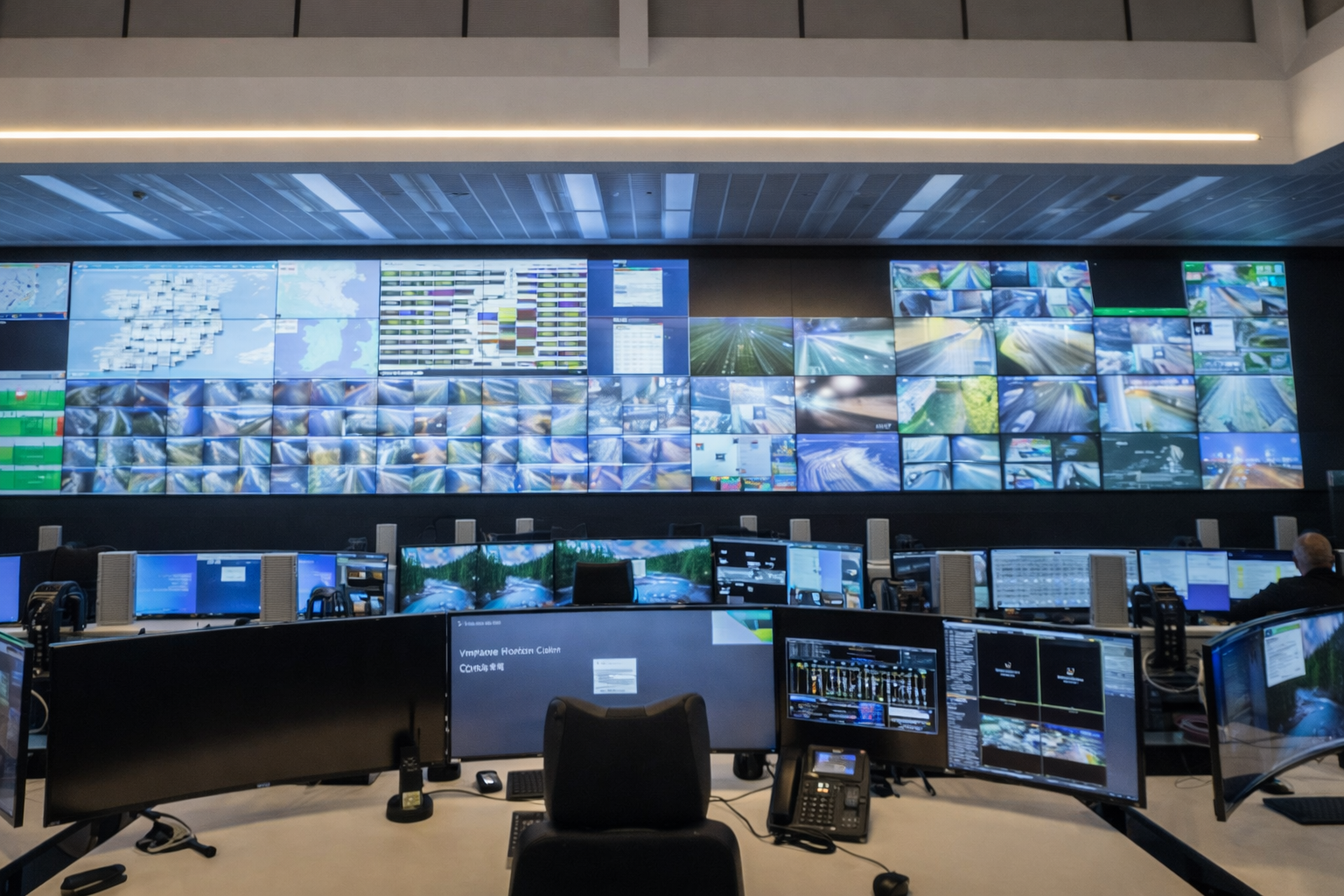
Why command centers fail in real crises and how visibility, coordination, and AV design impact fast, accurate decision-making under pressure
You invest in a command center. You test it. You run drills. Everything works.
Then a real incident hits.
Data floods in. Calls spike. Teams overlap. Decisions slow down. Screens show data, but no one agrees on what matters.
You start asking:
- Why does a system that works in drills fail under pressure?
- Why do teams struggle to coordinate when timing matters most?
- Why does visibility break when you need it the most?
These are not rare failures. They show how command environments are designed for control, not for chaos.
Across sectors, from public safety to defense to enterprise operations, the same pattern repeats. Systems pass tests but fail during real escalation.
The difference lies in pressure. Real situations bring volume, uncertainty, and time constraints that expose hidden gaps.
Let us break down where command centers fail and what those failures reveal.
The Illusion of Control in Simulated Environments
Controlled drills follow a script. Inputs arrive in sequence. Teams know their roles. Systems process limited data.
This creates a false sense of readiness.
In real conditions:
- Inputs arrive at once, not in sequence
- Data sources conflict
- Teams act without full context
- Decisions need a faster turnaround
A drill might simulate 50 alerts. A real situation generates thousands within minutes.
At present, the war between America, Iran, and Israel in the Middle East, as well as the ongoing war between Russia and Ukraine, has created a significant impact and increased the workload for command centers in operation. In addition, turmoil in Sudan, the Sahel, and in certain parts of Asia also added pressure on the command centers, which receive streams of information simultaneously.
In fact, these inputs include not only surveillance, cyber-intelligence, logistics, field operations data, etc., but are often overlapping and inconsistent.
The gap becomes clear. Systems built for predictable flows fail under unpredictable load.
Visibility Does Not Fail Because of Lack of Data
Most command centers do not suffer from a lack of data. They suffer from excess without structure.
When pressure rises, visibility problems appear first. Not because screens go blank, but because they show too much without hierarchy.
Operators begin to scan instead of read. Decision-makers begin to ask for summaries instead of trusting displays.
This is a design issue.
A large video wall with multiple feeds looks comprehensive. But if every feed carries equal visual weight, nothing stands out. Critical signals blend into background noise.
Consider a scenario where a city command center tracks traffic, emergency calls, and surveillance feeds during a major disruption.
All systems remain functional. Yet the operator must manually shift attention between feeds to identify priority events. The system presents information, but it does not guide attention.
That difference matters.
True visibility is not about access. It is about direction. It tells you where to look first.
Coordination Breaks When Systems Do Not Share Context
Command centers bring multiple teams together for a reason. No single unit handles complex situations alone.
But coordination does not improve by simply placing teams in the same room.
In controlled settings, roles are clear. Each team knows when to act. Communication follows a defined path.
In real conditions, roles overlap. Multiple teams respond to the same signal. Authority becomes situational.
Without a shared operational picture, each team interprets data independently. This creates parallel decisions instead of coordinated action.
You start to see patterns:
- Messages repeat across channels.
- Teams confirm information that already exists in the system.
- Decisions slow down because alignment takes longer than action.
The issue is not communication volume. It is the absence of shared context.
A command center must act as a single source of operational truth. If each system or team holds a different version of reality, coordination becomes negotiation instead of execution.
Information Flow Slows Down
Speed matters. A delay of minutes changes outcomes.
Yet information flow often slows during escalation.
Key reasons:
- Manual data validation steps
- Overloaded communication networks
- Lack of automation in routing information
- Dependence on human interpretation
A simple example:
An alert enters the system. It needs validation, tagging, and routing.
In drills, this takes seconds.
In real conditions, with hundreds of alerts, the process slows.
The system becomes a bottleneck instead of a support.
Technology Is Not the Problem. Fragmentation Is.
Most organizations invest in advanced tools. High-resolution displays, surveillance systems, communication platforms, analytics dashboards.
Each system performs its role well.
The problem appears when these systems need to work together.
Fragmentation forces operators to act as connectors between systems. They switch screens, compare data, and manually build context.
This increases cognitive load. It also introduces delay and error.
A fragmented system behaves like multiple independent units sharing space. An integrated system behaves like a single environment.
The difference becomes visible only under pressure.
Human Factors Get Ignored
Command centers focus on systems. They often ignore human behavior.
In high-pressure situations:
- Cognitive load increases
- Attention span drops
- Error rates rise
- Communication becomes fragmented
If interfaces are complex, users struggle.
If displays are cluttered, users miss key signals.
If workflows are rigid, users bypass systems.
Example:
An operator monitoring multiple feeds needs to identify a critical anomaly.
If the interface shows ten equal-priority alerts, the operator wastes time sorting.
Design must reduce effort, not add to it.
Latency Quietly Undermines Trust
Latency rarely shows up during testing. Systems appear responsive within acceptable limits.
In real conditions, even minor delays start to affect trust.
If a video feed lags, operators question its accuracy. If data updates are not synchronized, teams rely on verbal confirmation instead of visual systems.
This shift is critical.
Once users stop trusting the system in real time, they create parallel communication paths. These paths are slower and less reliable.
Latency does not only affect speed. It affects confidence in the system.
What Real-Ready Command Centers Do Differently
To handle real situations, command centers need a different approach:
- Unified Visibility
- Single operational view across systems
- Real-time data aggregation
- Clear prioritization of alerts
- Integrated Systems
- Seamless data sharing between platforms
- Elimination of silos
- Automated workflows
- Low Latency Infrastructure
- Instant data updates
- Real-time video streaming
- Fast communication channels
- Human-Centric Design
- Simple interfaces
- Clear visual hierarchy
- Reduced cognitive load
- Scalable Architecture
- Ability to handle a surge in data
- Flexible system expansion
- Stable performance under stress
The Role of Audio-Visual Infrastructure
Audio-visual systems sit at the core of command centers.
They define how information is displayed, shared, and understood.
Strong AV infrastructure delivers:
- High-resolution video walls with real-time updates
- Seamless switching between data sources
- Zero-latency content delivery
- Clear audio communication across teams
Weak AV systems create:
- Delays
- Misalignment
- Information gaps
In high-pressure environments, clarity of display directly impacts decision quality.
Checklist: Is Your Command Center Ready?
Ask these questions:
- Do you have a single unified display of all critical data?
- Can your systems handle sudden spikes in input?
- Are your communication channels integrated?
- Is your AV infrastructure delivering real-time clarity?
- Are your interfaces designed for high-pressure use?
If the answer to any of these is no, the risk remains.
Conclusion
Command centers do not fail because of a lack of investment. They fail because they are designed for stable conditions and tested in controlled environments.
Real situations remove those controls. They increase volume, compress time, and demand coordination without friction.
To operate effectively under these conditions, command environments need more than functional systems. They need integrated, real-time, human-centric design.
Resurgent AV builds these environments.
For agencies managing large operations and delivering critical services, Resurgent provides audiovisual solutions that maintain clarity under pressure. Our command center systems deliver high-quality, zero-latency content so every team sees the same information at the same moment.
From large-scale command setups to collaborative meeting spaces, Resurgent creates infrastructure that supports fast, aligned decision-making across locations.
With deep experience, structured deployment, and a focus on seamless performance, we ensure that your systems do not slow down when the situation intensifies.
If your command center needs to perform beyond controlled scenarios, it is time to rethink how it is designed.
Connect with Resurgent AV to build an environment where visibility stays clear, coordination stays aligned, and decisions move at the speed your operations demand.
FAQs
- Why does a command center that works in drills fail in real situations?
Because real events bring chaos, not sequence. Data floods in, conflicts arise, and systems struggle to keep up.
- Is the issue too little data or too much?
Too much. The problem is unstructured data that lacks clear priority, so teams miss what matters.
- Why do teams struggle to coordinate during crises?
They don’t share a single real-time view, so everyone interprets the situation differently.
- Does AV setup really affect decisions that much?
Yes. If information is delayed or unclear on screens, decisions slow down, and trust drops.
- How does Resurgent improve command center performance?
Resurgent builds zero-latency, integrated AV environments so your teams see clearly, align faster, and act without delay.