Home >>
Blogs
>>
Why Organizations Should Focus On Designing Outcomes
Why Organizations Are Moving From Designing Spaces to Designing Outcomes
Organizations now prioritize performance over floor plans. Learn why workplace infrastructure focus is shifting from physical design to measurable business outcomes.
You walk into your office. The lobby has marble floors. The chairs cost more than a car. Sunlight fills the room. On paper, this office looks perfect. Then, you try to work.
You need to host a video call with a team in London. The audio cuts out every three minutes. You try to share your screen. The cable does not fit your laptop. You move to a huddle room. The echo makes you sound like you are in a cave. Your expensive office has failed you.
Many leaders face this issue. They spent years designing spaces. They focused on square footage. They focused on furniture. They forgot about the work itself. Now, the tide is changing. Organizations are moving away from designing spaces. They are now designing outcomes.
What Does Designing Outcomes Mean
Designing for outcomes starts with a question. What do you want to achieve? This is different from asking how many desks you need.
When you design a space, you focus on the physical layout. You look at walls, desks, and carpet. When you design an outcome, you focus on the human experience. You look at how fast teams make decisions. You look at how clearly people communicate. You look at how often people collaborate without frustration.
Outcome-based design treats the office as a tool. A hammer is only good if it drives nails. An office is only good if it helps your business grow.
Space Design vs Outcome Design
Feature
Space-First Design
Outcome-First Design
Primary Goal
Aesthetics and capacity
Performance and clarity
Success Metric
Square foot usage
Speed of decision making
Tech Role
Added after the room is built
Built into the strategy
User Experience
Forced to adapt to the room
The room adapts to the user
Flexibility
Static layouts
Scalable infrastructure
Why The Shift Is Happening Now
The old way of working is gone. Before, everyone sat in the same building. You walked to a desk. You stayed there for eight hours. Communication happened face-to-face.
Today, work happens everywhere. One person is in the office. Two people are at home. Another person is at a coffee shop. If your office design only accounts for the people in the room, you lose.
Remote Work Changed Everything
Hybrid work extinguished the traditional office. You no longer need five floors of desks. You need spaces where remote workers feel present. This requires a shift in thinking. You are not building a room. You are building a bridge between locations.
Decision Speed Is The New Currency
Business moves fast. You cannot wait three days for a meeting. You cannot spend twenty minutes fixing a projector. Every minute of technical lag is a minute of lost profit. Organizations realize this. They want infrastructure that removes friction.
The Core Outcomes Organizations Want
When leaders talk about outcomes, they usually mean three things.
1. Seamless Collaboration
Collaboration should feel natural. You should be able to walk into a room and start a meeting in ten seconds. If you have to call IT every time you want to show a slide, your design failed. The desired outcome is a meeting where the technology stays out of the way.
2. High Quality Communication
Bad audio ruins deals. Bad video hides body language. The outcome you want is total clarity. Every participant should hear every word. Every person should see every detail on the screen. This is especially true for public sector agencies. These groups manage large areas. They deliver services to citizens. They need precision.
3. Scalable Operations
Your business will grow. Your office design must grow, too. A space-first design is hard to change. An outcome-first design uses scalable infrastructure. You add more locations or more users without starting over.
The Role Of Audio-Visual Technology
You cannot reach these outcomes with just furniture. You need the right technology. Audio-Visual (AV) solutions are the nervous system of the modern office.
Think about a command center. A command center manages emergency responses or city traffic. The people in that room need to see high-quality content. They need zero latency. Latency is the delay between an event and the image on the screen. In a crisis, a three-second delay is too long.
Designing for this outcome means choosing the right AV tools. You need screens with high resolution. You need processors that handle data fast. You need a layout where everyone sees the data clearly.
Examples of Outcome-Driven AV
Meeting Rooms: The outcome is inclusion. You use cameras which follow the speaker. You use microphones which filter out background noise. Remote workers feel like they are at the table.
Training Centers: The outcome is knowledge retention. You use interactive displays. You use audio systems which ensure the person in the back row hears as well as the person in the front.
Public Agencies: The outcome is transparency. Large displays show real-time data to officials. This allows for faster responses to public needs.
Why Aesthetics Are Not Enough
A beautiful office is like a nice car with no engine. It looks good in the driveway. It does not get you to work.
I recently spoke with a manager who worked in a “modern” office. The walls were all glass. The floors were polished concrete. It looked like a museum. He didn’t really like it. Why? The glass caused glare on every screen. The concrete floors made every footstep sound like a drum. He could not hear his clients properly on the phone.
The designer focused on the look. The designer ignored the outcome of quiet concentration.
How To Start Designing For Outcomes
If you want to make this shift, follow these steps.
1. Identify Your Pain Points
Stop looking at Pinterest for office ideas. Start looking at your team. Ask these questions:
Where do projects get stuck?
Why do meetings start late?
Do remote employees feel ignored?
Is data hard to see or share?
2. Define Success Early
Before you hire a contractor, define what a win looks like. A win is not “a nice conference room.” A win is “a room where three different teams can share content at the same time with zero setup time.”
3. Focus On Infrastructure Over Furniture
Tables and chairs are easy to replace. Wiring, software, and hardware are harder. Invest in the bones of your office. Make sure your AV infrastructure is versatile. It should work with different devices. It should work with different software.
The Importance Of Precision
In many industries, “good enough” is not enough. Public sector agencies are a great example. These agencies administer large areas. They deliver varied services to citizens. They require audiovisual technology that is scalable yet precise.
Imagine a city command center. The operators look at dozens of camera feeds. They monitor power grids or water levels. They need high-quality multimedia content. They need zero latency. If the technology fails, the city suffers.
This is why organizations now look for experts who understand these stakes. They are not looking for a TV installer. They are looking for a partner who builds systems for results.
Who Is Resurgent AV
We are Resurgent AV. We create productive collaborative experiences for you with our interactive environments. We transform the way you share information. We help you stay one step ahead. Always!
Business environments evolve fast. Faster decision-making is now a requirement. ResurgentAV has over a decade of experience. We understand your needs. We deliver time-efficient solutions. These solutions streamline workplace collaboration. They optimize workflow. They increase productivity.
Our advanced technical know-how ensures a superior user experience. Our custom-built deployment plans fit your specific goals. We use extensive quality control programs. This ensures the technology functions at all times.
Our Enterprise Project Delivery Team aligns schedules with your business goals. We keep you updated throughout the project. We ensure timely delivery. No matter your business, our scalable infrastructure solutions will simplify communication!
Our Approach To Corporate AV
Our corporate AV solutions help organizations stay ahead. We help you stay agile. This is true even as you expand globally. Work cultures are now hybrid. Audio-video integration is no longer about a single space.
Our AV solutions transcend spaces. They connect people across multiple locations. They work across multiple devices. We empower teams to reach company goals.
Agencies that administer large areas need the best tools. We provide command center audiovisual solutions. These display high-quality content with zero latency. We provide meeting room facilities. These enable discussions with multiple local and remote participants. Our offerings create the audiovisual infrastructure essential to the effective functioning of public sector agencies.
Take The Next Step
Stop thinking about how your office looks. Start thinking about what your office does.
Are you ready to move from designing spaces to designing outcomes?
Contact us to start your transformation. At Resurgent AV, we are ready to transform the digital experiences for your team now and for the future. Let us build the infrastructure you need to succeed.
FAQs
What is the main difference between designing a space and designing an outcome? Designing a space focuses on furniture and layout. Designing an outcome focuses on how your team performs and how quickly you make decisions.
Why is audiovisual technology so important for this shift? AV tools act as the bridge between your physical office and remote workers. Clear audio and video ensure every team member stays productive regardless of their location.
Does this approach work for small teams or only large public agencies? It works for everyone. Small teams benefit from faster workflows and fewer technical delays just like large organizations do.
Will an outcome-based design cost more than a traditional office setup? It is an investment in efficiency. You save money over time by reducing technical downtime and making better use of your existing square footage.
How does Resurgent AV help me move toward an outcome-driven workplace? Resurgent AV builds scalable AV infrastructure that fits your specific business goals. Contact our team today to start your digital transformation!
How To Create Consistent Employee Experiences Across Hybrid Town Halls
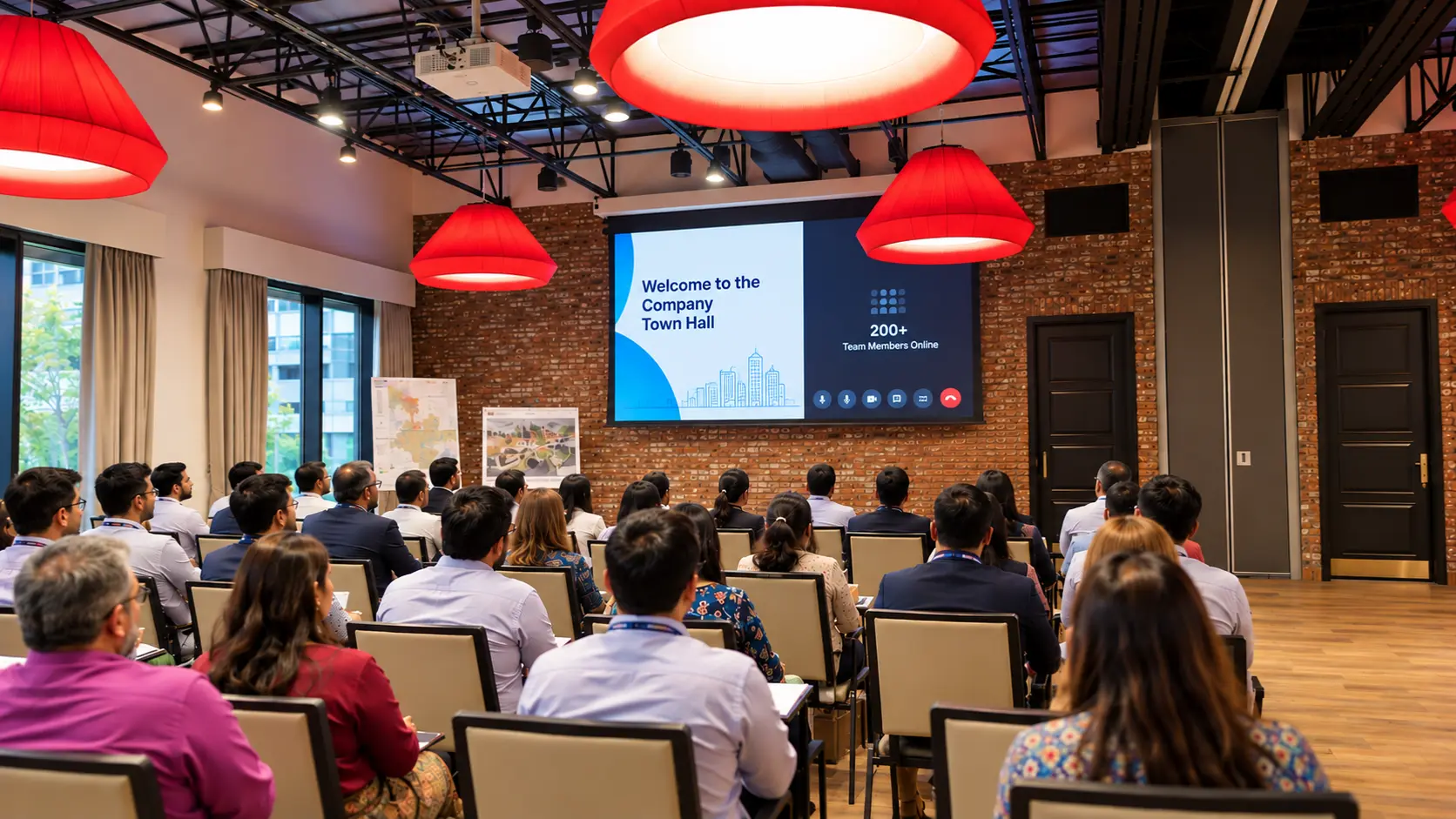
A company-wide town hall follows one script. Yet the employee in the boardroom hears clear audio while the one joining from a home office fights lag and echo. The auditorium group sees crisp slides. Remote staff squint at pixelated faces. Consistency ends up failing here. This gap hurts engagement. People feel left out when the […]
You start with a few meeting rooms. Each one gets its own display, camera, speaker, and control panel. Someone installs the gear. Someone else books a room and hopes the call works. That approach works when you have ten rooms, often supported by local audio-visual service providers. It breaks when you have 200+ rooms across […]
Most offices focus on boardrooms. Yet daily work happens in smaller spaces. These rooms are where quick discussions, hybrid check-ins, and brainstorming sessions occur. If your huddle rooms feel cramped, sound poor, or take too long to set up, you are not alone. Small meeting rooms often create big operational problems. The reasons are simple […]