Blogs - Posted on February 26, 2026

The Myth of the Standard Meeting Room

The Myth of the Standard Meeting Room

Rethink the standard meeting room. Learn how finance reviews, board updates, and cross-region meetings need different AV design and spatial intent.

Does every meeting room in your office look the same?

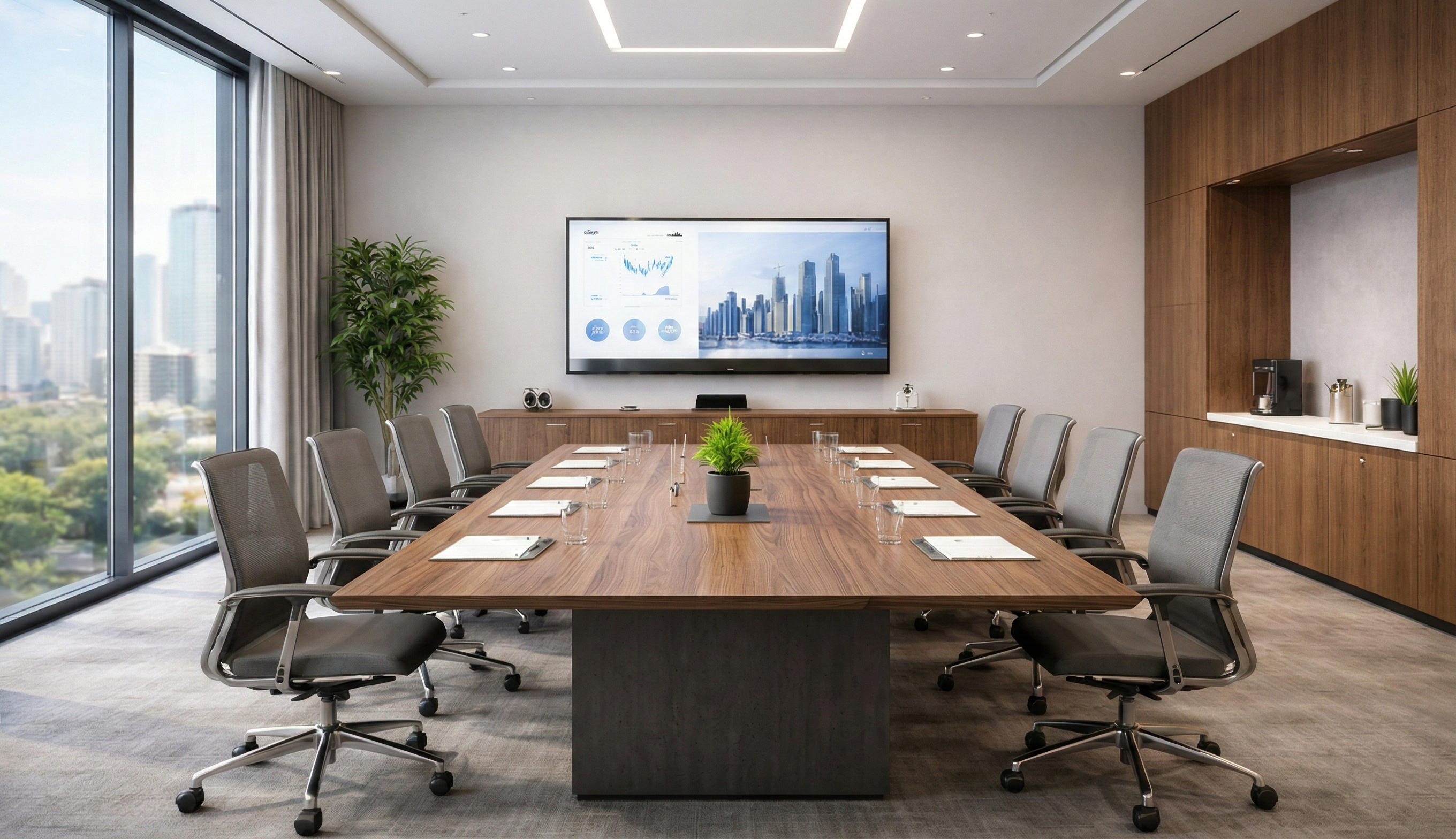
Same table. Same chairs. Same screen. Same camera.

Now ask yourself.

Do all your meetings behave the same way?

  • A finance review demands scrutiny.
  • A board update demands authority and discretion.
  • A cross-region review demands flawless hybrid collaboration.

Yet most enterprises replicate one room template across floors, cities, and countries.

You standardize furniture. You standardize AV. You standardize the layout.

Then you wonder why meetings feel slow, misaligned, or unproductive.

The problem is not your people.

The problem is the myth of the standard meeting room.

1. Why Enterprises Default to Templates

Templates reduce procurement effort.

They simplify budgeting.

They look consistent in design brochures.

  • Facilities teams love repeatability.
  • Finance teams love predictable costs.
  • IT teams love uniform hardware.

But uniformity ignores intent.

When you design rooms by template, you design for average behavior.

Most critical meetings are not average.

2. Intent Should Drive Design

Every meeting has a purpose. That purpose shapes how people speak, listen, decide, and collaborate.

Instead of asking, “How many seats do we need?” ask:

  • What decisions happen here?
  • Who speaks the most?
  • Who joins remotely?
  • What level of confidentiality is required?
  • How fast decisions must move?
  • How often data needs to be reviewed in detail?

When you shift from template thinking to intent thinking, room design changes immediately.

3. Let Us Break Down 3 Common Enterprise Scenarios

1. Finance review rooms demand precision

Quarterly finance reviews are detail-heavy. Leaders review spreadsheets, forecasts, margins, and risk models.

These sessions require:

  • Clear visibility of dense data
  • Minimal audio lag
  • Strong microphone pickup for detailed discussion
  • Tight integration with collaboration platforms

In a generic room, you often see:

  • A single large screen placed too far from participants
  • A wide-angle camera optimized for casual collaboration
  • Basic speakers not tuned for clarity

The result? Participants squint at numbers. Remote attendees struggle to read small text. Side conversations start.

A finance review room should look different.

Design considerations:

  1. Dual displays for data and participant view
  2. High-resolution display panels
  3. Close-range intelligent cameras
  4. Ceiling microphones with noise suppression
  5. Direct integration with platforms like Microsoft Teams

Products such as Microsoft Surface Hub 2S and Crestron Flex provide structured collaboration and structured control. Paired with Microsoft Teams, you create a focused review environment.

2. Board update rooms require authority and control

Board meetings differ from operational reviews. They carry governance weight. Sensitive discussions. Strategic direction.

The room itself influences behavior.

A boardroom requires:

  • Structured seating
  • Balanced camera framing
  • Secure content sharing
  • Controlled acoustics
  • Premium display clarity

Hybrid board meetings raise the stakes. External directors may join remotely. Every voice matters.

In a standard room template, you often find:

  • Inconsistent camera angles
  • Echo from untreated walls
  • Cables scattered across tables
  • Unmanaged device sharing

That setup reduces confidence.

Instead, boardrooms need:

  1. Centralized AV control systems
  2. Structured table microphones
  3. Intelligent video bars like Jabra PanaCast for natural framing
  4. Secure wireless presentation tools such as AirServer
  5. Integrated scheduling and digital signage, like PADS4 Digital Signage, outside the room

Authority comes from structure. Structure comes from intentional AV design.

3. Cross-region reviews demand hybrid equity

Global enterprises conduct cross-region reviews weekly. Teams join from Mumbai, London, Singapore, and New York.

Hybrid fatigue sets in when remote participants feel secondary.

Common template mistakes include:

  • One camera capturing the whole room
  • A single microphone at the center
  • No visual feedback to in-room participants about remote reactions

Remote participants interrupt. Audio overlaps. Decisions slow down.

Cross-region rooms require hybrid equity.

Design requirements:

  1. Multiple microphones for equal pickup
  2. Intelligent camera tracking
  3. Clear participant view screens
  4. Low-latency platform integration
  5. Reliable connectivity redundancy

Solutions like Crestron Flex systems integrated with Microsoft Teams provide seamless hybrid functionality. Jabra PanaCast ensures remote participants see every speaker clearly.

When remote and in-room participants share equal visibility and audibility, meeting quality improves.

4. A Quick Comparison

Below is a simplified comparison of intent-driven design versus template-driven design.

Meeting TypeTemplate Room SetupIntent Driven Setup
Finance ReviewSingle display, wide cameraDual high-resolution displays, focused camera, ceiling mics
Board UpdateGeneric seating, basic AVStructured layout, premium audio, secure sharing
Cross-Region ReviewOne camera, one micMulti-mic coverage, intelligent framing, hybrid integration

5. The Financial Cost of Poor Room Intent

Meeting inefficiency has a cost.

Consider this example.

A leadership team of 10 meets for two hours weekly. The average hourly executive cost is significant. If poor AV wastes 15 minutes per session, across 50 weeks, you lose more than 125 executive hours annually.

Now multiply across regions.

The cost of redesigning the room intent often proves lower than the cost of recurring inefficiency.

6. Behavior Shapes Technology Needs

Observe how behavior changes by meeting type.

In finance reviews:

  • People lean forward
  • Screens dominate attention
  • Silence increases during analysis

In board meetings:

  • Speakers present in sequence
  • Remote participants must remain visible
  • Confidentiality is high

In cross-region reviews:

  • Interruptions occur frequently
  • Non-verbal cues matter
  • Screen sharing rotates often

One room template fails to support all three behaviors.

7. From Standardization to Intelligent Segmentation

Enterprises should still standardize.

But standardize by category, not by floor.

Define room categories based on intent:

  • Decision rooms
  • Review rooms
  • Collaboration rooms
  • Training rooms
  • Innovation rooms

Assign AV and spatial standards to each category.

For example:

Decision rooms

  • Structured seating
  • Integrated Crestron Flex systems
  • Dual displays
  • Advanced audio coverage

Review rooms

  • High-resolution displays
  • Microsoft Surface Hub 2S
  • Intelligent whiteboarding via Samsung Flip

Collaboration rooms

  • Flexible furniture
  • Jabra PanaCast
  • Wireless sharing through AirServer

This approach keeps procurement predictable while aligning rooms with behavior.

8. The Role of Digital Signage and Scheduling

Meeting room behavior starts before the meeting begins.

PADS4 Digital Signage outside rooms clarifies booking status, meeting purpose, and ownership.

Clear visibility reduces conflicts and delays.

When participants know the intent before entering, expectations align faster.

9. Hybrid Culture Demands Dynamic Rooms

Work culture shifts quickly. Teams move between in-office and remote attendance.

Rigid templates fail under dynamic attendance patterns.

Rooms should support:

  • Quick device connection
  • Seamless platform switching
  • Instant screen sharing

If a room struggles to adapt within minutes, productivity drops.

10. A Practical Framework for Leaders

You can audit your meeting spaces in three steps.

Step 1: Map meeting types
List your top five recurring meeting formats. Identify participants, duration, and decision complexity.

Step 2: Observe behavior
Attend sessions. Note where friction occurs. Audio clarity. Screen visibility. Remote participation gaps.

Step 3: Align AV to intent
Match hardware and layout to observed behavior. Avoid one-size-fits-all procurement.

This process shifts focus from furniture aesthetics to decision performance.

11. Why Enterprises Delay This Shift

Many leaders assume AV equals screens and speakers.

Modern corporate AV spans integration, platform alignment, power management, remote equity, and workflow alignment.

As organizations expand globally, cross-location collaboration intensifies. Audio-video integration no longer serves a single room. It connects people across locations and devices.

Without intent-driven design, global growth multiplies inefficiency.

12. Resurgent Helps You Design for Intent

We design rooms by intent. Finance reviews get precision. Board updates get authority. Cross-region reviews get hybrid equity.

We build scalable infrastructure that simplifies communication and strengthens collaboration across locations.

If your meeting rooms look identical across floors and cities, start asking why.

Your meetings are not identical. Your decisions are not identical. Your rooms should not be identical.

Connect with Resurgent today. Let us assess your meeting environments, redefine room categories, and align AV design with business intent. Transform your meeting spaces into structured decision environments that support your teams today and as you grow into the future.

FAQs

  1. Aren’t all meeting rooms supposed to be the same?

Not if your meetings are different. A finance review, a board update, and a cross-region call need different setups to work well.

  1. What does “designing by intent” really mean?

It means setting up the room around the meeting’s purpose, who speaks, who joins remotely, and how decisions get made.

  1. How do we fix this in our organization?

Partner with Resurgent to assess your meeting types, redefine room categories, and implement AV solutions aligned with real business intent.

Related blogs

February 19, 2026
Why Some Meetings Drain People Before the Workday Even Starts

Why Some Meetings Drain People Before the Workday Even Starts

Early meetings drain energy when audio, visuals, and room comfort fail. Learn how better AV design protects focus and improves team output. Do you join a 9 a.m. meeting and feel tired before your first task? Do you struggle to follow voices or read shared screens? Many teams begin the day with friction. Early meetings […]

Read more  
February 12, 2026
Why Leadership Conversations Break Down First And How Rooms Play a Role

Why Leadership Conversations Break Down First And How Rooms Play a Role

Why leadership conversations fail due to room design. Learn how audio delay, eye-line gaps, and AV fatigue weaken executive decisions. Have you noticed this pattern? The strategy looks solid on paper. The leaders agree in pre-reads. The numbers align. Then the meeting begins, and something shifts. People repeat points. Someone asks to restate a question. […]

Read more  
February 5, 2026
When the Room Becomes the Third Person in the Deal

When the Room Becomes the Third Person in the Deal

How meeting rooms shape authority, trust, and deal outcomes. Learn how AV design influences senior buyers during high-stakes business conversations. You walk into a boardroom ready to close a deal. The numbers hold. The strategy feels tight. The people around the table look prepared. Yet something feels off. The screen flickers. Audio lags. Someone struggles […]

Read more  

Copyright @ 2024 Resurgent. All rights reserved.