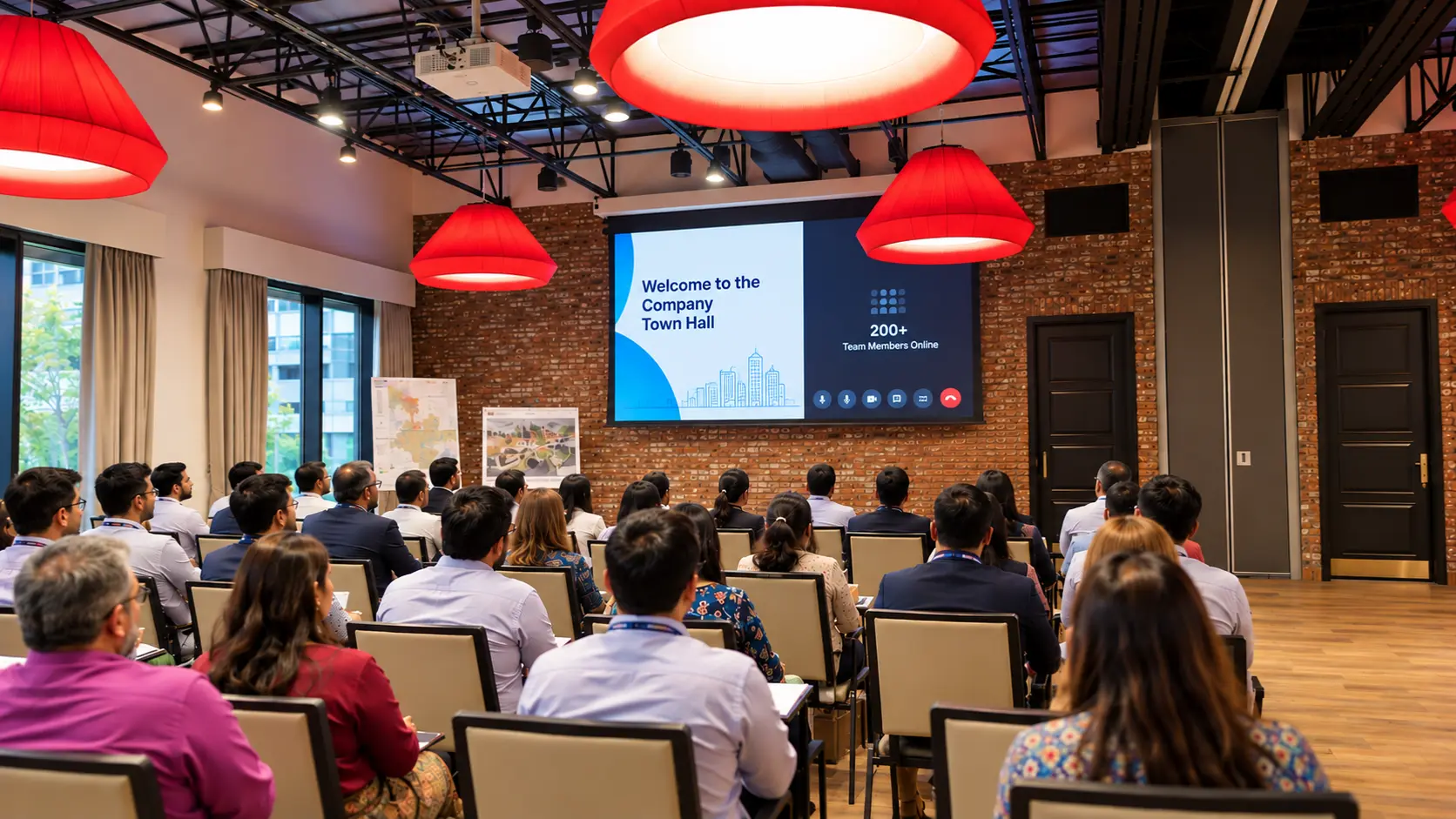
Employee distraction is not a personal failing, it is a systems failure. Learn how fragmented tools and poor meeting room design impact employee attention in the workplace, making it a critical infrastructure challenge.
You schedule a critical meeting. You book the conference room. You share the agenda. You walk in, and the screen takes 90 seconds to wake up. The soundbar does not connect. You fumble with six different cables while a senior stakeholder watches.
The meeting starts late. The first speaker shares their screen, but the video feed from the remote participant freezes. Someone in the back starts typing loudly. Another person joins from their laptop with their microphone on. You lose the thread of the conversation.
This is not a story about one bad meeting. This is a story about broken infrastructure.
We treat attention as an individual responsibility. We tell employees to focus. We tell them to close their tabs. We tell them to mute notifications.
The data suggests we are wrong.
Studies reveal knowledge workers change tasks every 3 minutes. You lose deep focus for more than 23 minutes after interruptions. This math is not working for a company running complex global operations. It is unreasonable to expect people to focus more when their tools constantly fight against them.
The Real Cost of Fragmented Experiences
Your organization probably runs on multiple platforms. Teams uses one video system. Zoom runs another. Some executives prefer Webex. Your clients use Google Meet. Your internal collaboration platform has its own calling feature.
Each platform has its own interface. Each one handles screen sharing differently. Each one requires a separate login. Each one produces a unique audio experience for the listener.
It prevents an easy flow of information. Mental energy is spent re-orienting every time an employee switches platforms. They aren’t focused on the subject matter of the conversation. They’re contemplating which button to press.
Consider this scenario:
- A product manager needs to present a roadmap to a distributed team. Four people are in the office. Three are remote. One is calling from their car. Two are joining from a client site.
- The product manager starts the meeting. The in-room system fails to sync with the remote participants. The audio from the car caller is choppy. The client site connection drops twice.
- The product manager now manages technology. They ask, “Can you hear me?” multiple times. They repeat key points for the person whose connection lagged. They apologize for the delays. They lose their place in the presentation.
This is not a failure of personal productivity. This is a failure of systems design.
The infrastructure did not support the work. The employee paid for that failure with their attention and their professional credibility.
Why Inconsistent Room Behavior Is the Silent Killer
Meetings happen in many spaces. Each room should work the same way. Each room should provide the same experience. That is rarely true.
You might have a Boardroom with a high-end system. It works flawlessly. The Town Hall space has a different setup. The small huddle room has an older display. The training room uses a different conferencing platform.
Employees learn how to work in one room. They walk into another room and find a completely different system. They waste time figuring out the basics. They struggle to connect their laptop. They cannot find the mute button. They accidentally share their desktop with personal notifications visible.
This variability trains employees to expect failure. They prepare for technical problems. They leave extra time for troubleshooting. They keep their presentations simple in case the system cannot handle complex media.
That is attention wasted. That is energy diverted from high-value work to low-value tech support.
The Interaction Overload Problem
Modern collaboration demands that employees pay attention to multiple streams. You need to watch the speaker. You need to read the chat. You need to monitor your own camera. You need to track body language in the room and on the screen.
This is quite unnatural. The human brain has limited processing capacity. When employees are made to handle multiple channels, they are forced to split their focus. They are not particularly good at anything.
When people take on two cognitive tasks at the same time, their productivity drops by 40%, research shows.
An employee might lead four or five at a hybrid meeting. Here is what that looks like in practice:
- A leader speaks to a mixed audience of in-room and remote employees.
- The remote employees type questions in the chat.
- The in-room employees raise their hands.
- The leader misses the chat questions because they look at the room.
- The remote employees feel ignored.
- The in-room employees interrupt because they do not see the chat activity.
- The meeting runs long.
- Key decisions are delayed.
- Follow-up emails are sent to clarify the misunderstandings.
This is not a communication problem. This is a design problem. The technology should unify these experiences. It should bring the chat into the room. It should bring the room into the chat. It should make the leader’s job easier, not harder.
Treating Attention as Infrastructure
Here is a different way to think about this. Your company invests in Wi-Fi. It invests in servers. It invests in security. These are infrastructure assets. They support all work. They are not optional.
Employee attention deserves the same treatment. It is a finite resource. It is required for every task. It is depleted by friction, delay, and confusion. It must be protected and preserved.
What does attention infrastructure look like? It looks like systems that work predictably. It looks like rooms that behave consistently. It looks like platforms that integrate seamlessly. It looks like tools that reduce cognitive load instead of increasing it.
Consider the difference between these two environments.
Environment A:
- Each room has different conferencing hardware.
- You need adapters to connect your laptop.
- Audio quality varies by room.
- The camera is in a fixed position that does not show the whiteboard.
- Remote participants feel like outsiders.
- You end each meeting exhausted.
Environment B:
- Every room has the same system.
- You walk in, tap your phone or laptop, and the system connects instantly.
- The camera follows the speaker.
- The audio is crisp for everyone.
- Remote participants see the room clearly.
- The chat appears on the main screen.
- You end each meeting focused on the content.
Environment B is an investment in attention infrastructure. It does not require employees to think about technology. It allows them to think about strategy, problem-solving, and decision-making.
The Business Case for Fixing This
Distraction is expensive. You can calculate the cost. Take the average salary of your knowledge workers. Multiply it by the minutes wasted each day. Multiply that by the number of employees. Multiply that by the number of working days.
You get a significant number. And that number only counts direct time waste. It does not count the cost of poor decisions made in fragmented meetings. It does not count the cost of missed information. It does not count the cost of employee frustration and disengagement.
Gallup data shows that engaged employees are more productive and more likely to stay with their organization (21% less turnover). Disengagement often traces back to environmental factors. One major factor is the inability to do good work in meetings.
When meetings are consistently bad, employees disengage. They stop contributing. They multitask during calls. They schedule fewer collaborative sessions. They work in silos.
This is a structural problem. It demands a structural solution.
What Good Attention Infrastructure Looks Like
You need a foundation that supports every collaboration experience. This foundation must work across spaces, devices, and platforms. It must be simple for employees. It must be manageable for IT teams.
Here are the core components:
- Unified systems. Your meeting rooms should use a single platform that integrates with your preferred video and audio tools. This reduces friction. It eliminates the “which system is in this room” question.
- Consistent design. Every room should follow the same design principles. The microphone placement should be standard. The camera height should be standard. The control panel should be standard. This reduces cognitive load. Employees learn once and apply everywhere.
- Automated calibration. Audio should adjust to the room size and the number of participants. Video should adjust to the lighting conditions. The system should handle these adjustments automatically. Employees should not need to be audio engineers.
- Integration across platforms. Your system should work with Teams, Zoom, Google Meet, and other major platforms. Employees should not need to guess if the room supports their client’s preferred tool.
- Sound masking. This is often overlooked. Sound masking systems add ambient noise to control distractions. They prevent people in one meeting from hearing people in another meeting. They reduce the acoustic spillover that fractures attention.
This is attention infrastructure. This is the foundation for better work.
The Bottom Line
Employee attention is not an individual responsibility. It is a systems responsibility. You cannot fix it with training. You cannot fix it with policies. You cannot fix it with reminders to focus.
You fix it by designing the physical and digital environment to support focus. You fix it by reducing friction. You fix it by providing consistent experiences. You fix it by treating attention as the scarce resource that it is.
The organizations that understand this will win. They will have more productive meetings. They will have better decisions. They will have more engaged employees. They will move faster.
The organizations that ignore this will continue to struggle. They will accept mediocre meetings. They will lose productive time. They will watch talented employees become frustrated.
The choice is clear. You can keep asking employees to work harder against broken systems. Or you can fix the systems so employees can do their best work.
Make Attention Infrastructure a Priority
Resurgent provides integrated AV solutions that help organizations build this infrastructure. We design systems that transcend individual spaces and connect people across multiple locations and devices. Our approach empowers teams to focus on what matters.
We help you design:
- Unified Communication Systems
- Boardrooms
- Video-conferencing rooms
- Meeting rooms
- Cafeteria-town halls
- Training rooms
- Collaboration spaces
- Non-SOC rooms
- Light control solutions
- Sound masking solutions
- Experience centers
Stop asking your employees to struggle. Start building an environment that supports their attention. Contact Resurgent today to learn how our AV solutions can transform your workplace.
FAQs
- Why is my team so distracted during meetings, even when they are trying to focus? Not a personal failing. It is a system failure caused by inconsistent technology and fragmented platforms that force employees to manage tools instead of content.
- Is this an IT problem or a people problem? It is an infrastructure problem. When rooms work differently, and platforms do not integrate, employees waste time on troubleshooting. Fix the systems to fix the distraction.
- What exactly does workplace attention infrastructure include? Unified communication systems, consistent room designs, automated audio and video calibration, cross-platform integration, and sound masking to reduce acoustic distractions.
- How do inconsistent meeting rooms hurt my business results? They waste productive time, delay decisions, frustrate remote participants, and increase meeting length. These inefficiencies accumulate into lost revenue and disengagement.
- How can Resurgent help my organization fix these issues? Resurgent designs integrated AV solutions that unify your collaboration spaces and protect employee attention. Contact us to build infrastructure that supports focus and productivity.
Written By
Surendar Kannan
(Alchemist – Design & Estimation)