Home >>
Blogs
>>
Leadership Conversations Fail Room Design
Why Leadership Conversations Break Down First And How Rooms Play a Role
Why leadership conversations fail due to room design. Learn how audio delay, eye-line gaps, and AV fatigue weaken executive decisions.
Have you noticed this pattern?
The strategy looks solid on paper. The leaders agree in pre-reads. The numbers align. Then the meeting begins, and something shifts.
People repeat points. Someone asks to restate a question. A remote participant interrupts at the wrong moment. The energy drops. The room feels off.
Afterward, senior leaders blame alignment gaps. They question preparation. They question commitment.
Rarely do they question the room.
Leadership conversations break down first because they carry the highest cognitive load.
They involve ambiguity, risk, trade-offs, and incomplete data. When the physical and digital environment introduces friction, confidence erodes quietly.
Meeting rooms are not neutral spaces. They shape how leaders think, listen, and decide.
1. Leadership Conversations Operate Under Pressure
Executive discussions differ from operational reviews.
They include:
High financial stakes
Long-term consequences
Cross-functional dependencies
Political sensitivities
Compressed timelines
Cognitive science shows decision fatigue increases under ambiguity and stress. Add environmental friction, and the margin for clarity shrinks.
At senior levels, small distortions compound fast.
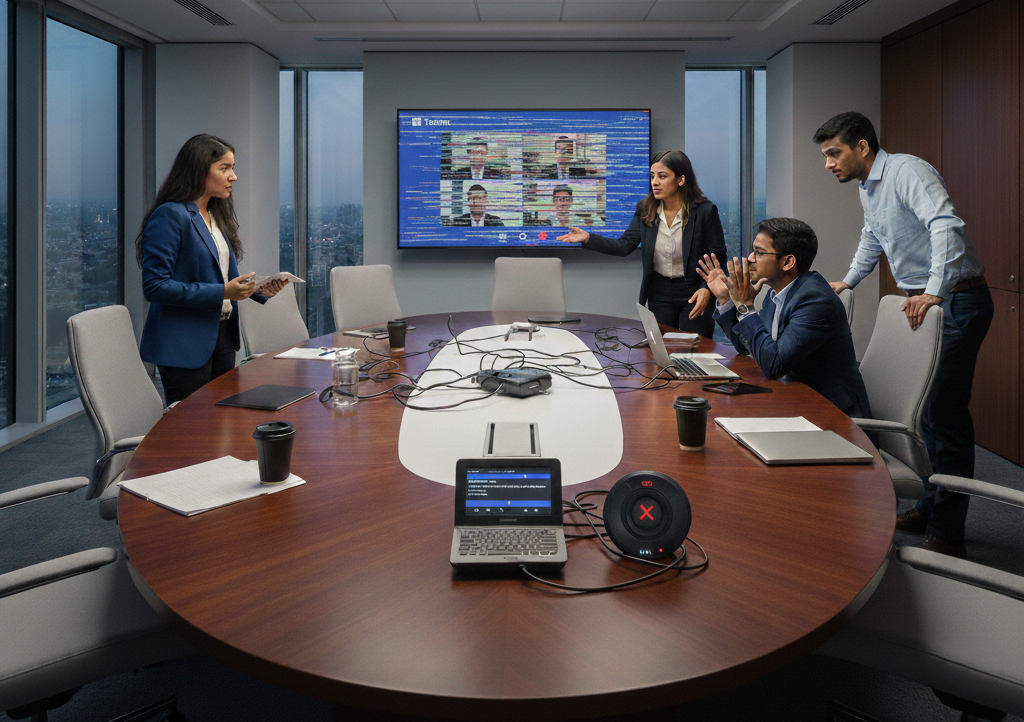
A delayed audio feed changes response timing.
A blurred face reduces emotional reading.
A mismatched eye-line signals disengagement.
None of these issues show up in the minutes. All of them influence outcomes.
2. The Hidden Risk Variable? The Room
Most organisations treat meeting spaces as infrastructure.
Chairs. Screens. Cameras. A platform login.
Yet rooms introduce measurable risk into leadership dialogue.
Consider three common breakdown points.
Audio Delay
Even a 300 to 500 millisecond delay alters conversational rhythm. People talk over each other. Pauses feel awkward. Leaders hesitate before responding.
In high-stakes discussions, timing communicates confidence. When timing falters, perceived authority shifts.
Example: A CFO presents revised projections. A board member asks a direct question. The CFO pauses, not by choice, but due to audio lag. The silence stretches. Confidence dips in the room.
No one names the delay. But the perception lingers.
Eye-Line Mismatch
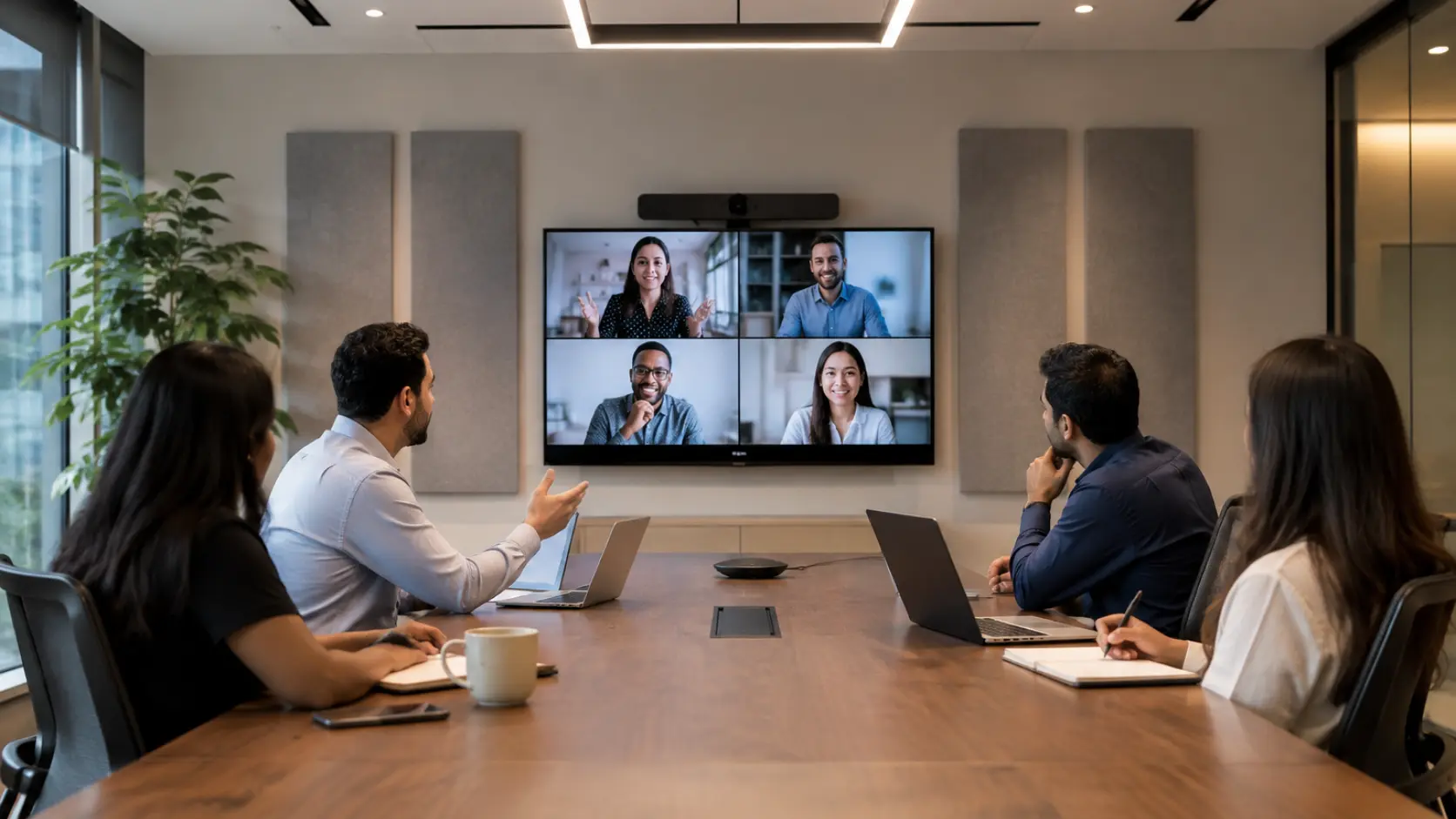
In hybrid meetings, leaders often look at screens instead of cameras. Remote participants see profiles, not eye contact. In-room attendees see partial engagement.
Eye contact drives trust. Research shows consistent eye contact increases perceived credibility and competence.
When cameras sit too high, too low, or too far, connection drops.
Remote leaders feel peripheral. But in-room leaders dominate unconsciously.
Visual Fatigue
Large screens with poor contrast, glare from lighting, or cluttered layouts increase cognitive strain.
Senior leaders process data fast. They scan dashboards. They read body language. They track tone shifts.
If the visual environment demands extra effort, mental energy drains earlier. Decision quality declines late in long sessions.
What appears as disengagement often reflects environmental fatigue.
3. How Room Friction Weakens Decision Confidence
Decision confidence forms through three signals:
Clear information
Clear social cues
Smooth interaction
Room friction disrupts all three.
Below is a simple comparison:
Factor
Optimized Room (Substance-Focused)
Friction-Heavy Room (Correction-Focused)
Audio
Real-time clarity; effortless listening.
Echo, lag, and constant interruptions.
Visual
High-resolution; correct life-like scale.
Glare, distortion, and screen crowding.
Camera
Natural eye-level alignment; high engagement.
Off-axis angles; disengaged “downward” framing.
Platform
Seamless, invisible integration.
Clunky app-switching mid-meeting.
Leadership Focus
Focus on substance: The message is the priority.
Split attention: Toggling between content and fixing tech.
Outcome
High confidence and immediate buy-in.
Lowered trust in conclusions and data.
4. Hybrid Leadership Is More Exposed
Global expansion and hybrid work amplify room risk.
A CEO in Singapore joins a strategy review in Mumbai. A product head connects from London. A private equity partner listens from New York.
If the collaboration stack lacks alignment across locations, influence skews toward whoever occupies the best physical room.
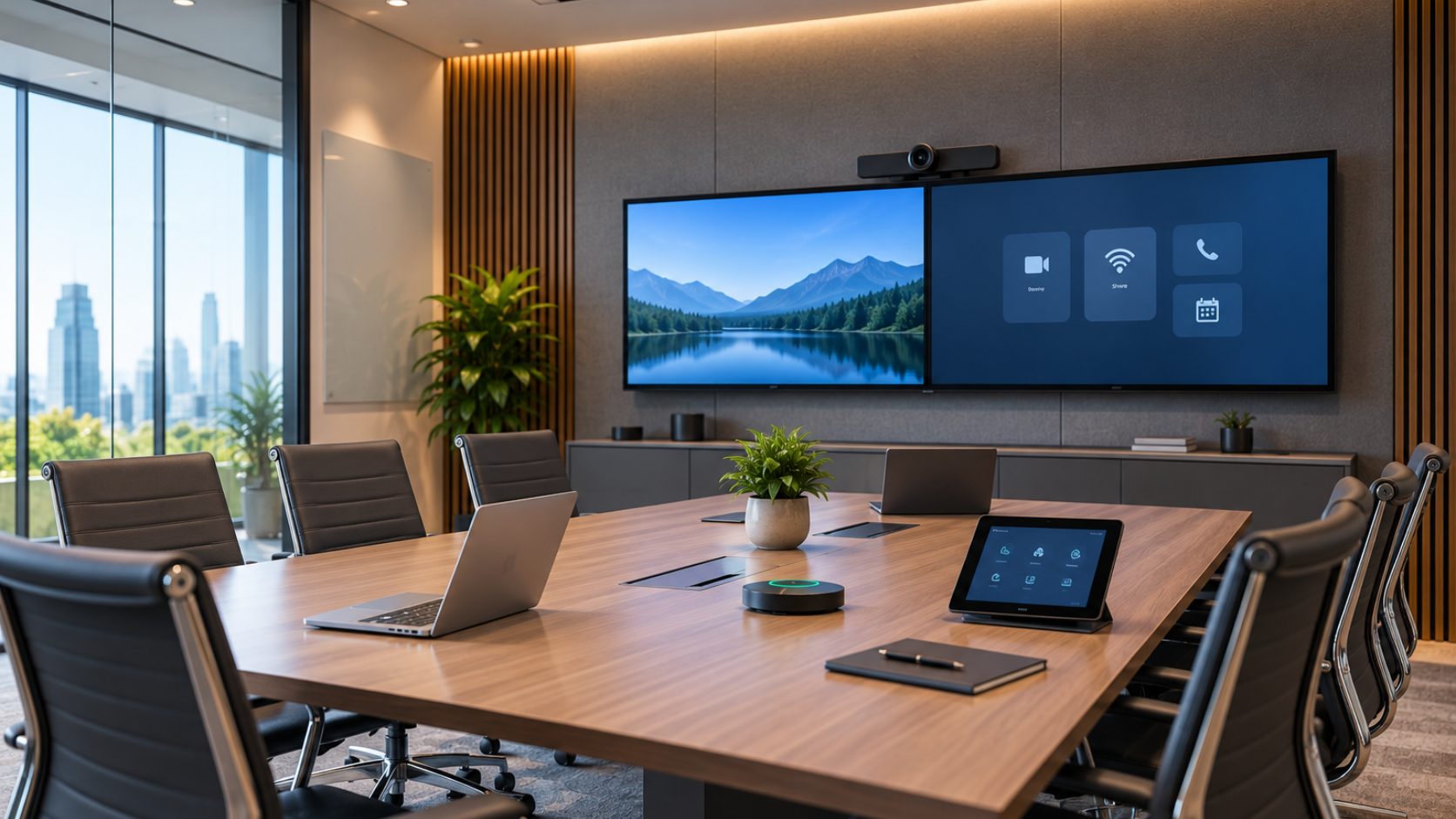
Devices must work as a coordinated system. Cameras must align with screen placement. Microphones must capture evenly across seating layouts. Digital whiteboards must sync across devices without delay.
Individually, each product supports collaboration.
Together, when deployed strategically, they remove friction from leadership dialogue.
6. Rooms Shape Power Dynamics
Room design influences hierarchy.
Large rectangular tables place some leaders at visual endpoints. Wide-angle cameras exaggerate distance. Ceiling microphones favor central seats.
Subtle signals accumulate.
If your global head of strategy appears small on-screen due to poor framing, perceived influence drops. If side conversations form because audio coverage weakens near walls, trust erodes.
Multiply these interruptions across weekly executive meetings, quarterly reviews, and investor updates. The cumulative impact is significant.
You cannot afford this erosion at scale.
8. Meeting Spaces as Strategic Infrastructure
Leadership rooms should be treated as strategic infrastructure, not facilities expense.
Think in terms of risk mitigation.
Financial risk: Misaligned capital allocation.
Reputational risk: Poor investor communication.
Operational risk: Delayed product pivots.
All stem from flawed executive dialogue.
Ask these questions:
Does every leader appear at eye level on-screen?
Does audio capture evenly across the room?
Do remote participants see the same data clarity as in-room attendees?
Does your AV system support expansion across new offices?
If the answer to any is uncertain, you carry invisible risk.
9. Conclusion
Leadership conversations break down first because they carry the greatest cognitive and strategic load. When rooms introduce friction through audio delay, eye-line mismatch, or visual fatigue, decision confidence erodes quietly.
The issue is not people.
The issue is the environment.
Meeting spaces act as risk variables in executive decision-making. When designed intentionally, they strengthen alignment, trust, and speed.
Resurgent builds collaborative environments that support high-stakes dialogue. With integrated AV systems, scalable infrastructure, and enterprise-grade deployment expertise, your leadership rooms evolve from functional spaces into strategic assets.
If your organisation operates across locations or hybrid teams, evaluate whether your current rooms support executive clarity.
Resurgent is ready to transform your digital collaboration experience.
How to Design Speech Intelligibility in Modern Meeting Rooms
How to Improve Speech Intelligibility in Modern Meeting Rooms Modern meeting rooms are no longer simply spaces with a display and a conference speaker. With hybrid collaboration, remote participants, video conferencing, and distributed teams becoming part of everyday business, clear and intelligible speech has become one of the most important factors in meeting room design. […]
The AV System Is Working. So Why Is the Experience Still Breaking?
Your meeting room shows green lights on every device. The control panel responds. The network reports no faults. Still, the first five minutes of every call feel broken.
Regular AV health checks prevent downtime, improve user experience, and reveal upgrade opportunities that deliver measurable ROI without new installs. Many AV providers still lead with installation pitches. New displays. New microphones. New control systems. But clients are not always asking for new technology. They are asking for reliability. They want every meeting, class, or […]